Showing posts with label Recomendations. Show all posts

Wednesday, December 9, 2009

Carrot and the Stick

Let me eagerly enjoy my sweet carrots.
Carrots are very low in saturated fats and cholesterol.

Good source of dietary fibre, vitamin A and vitamin C.

Carrots can be harvested while they are still immature.
Immature/ fresh-market carrots can be stored for 4 to 6 weeks at 0 degree Celcius and high (95 - 99 %) humidity.
Mature carrots can be stored up till 5 months in the same conditions.


Select carrots which are firm and darker orange, this indicate higher beta-carotene content. Avoid selecting dry, cracked, wilted or limp carrots which are pale in colour.


Cooking suggestions:

1) Raw - Shaved in salads or use baby carrots as vegetable sticks for dipping in sour cream.

2) Boiled - In soups, carrots give a rich sweet taste in soups when coupled with other root vegetables.

3) Steamed
4) Baked

5) Grilled - Grilling carrots makes it crisp on the outside and soft on the inside. We can season the carrots with Thyme and salt lightly. Remember to oil the carrots directly before grilling.

Yum!


-30-


Tuesday, December 1, 2009

Hot Line SOS - "Kelp Me!"

Kelp are large seaweeds belonging to brown algae.

You normally find them dried in the market.


They are a good source of Dietary Fiber, Vitamin C, Calcium, Iron, but can be high in sodium.

Storage Tips:
Keep dried kelp in a cool dry place, away from salt.
Use dehumidifiers if necessary.

Cooking Suggestions:

Always soak dried kelp at least 15 mins before consumption. Different types of kelp require varying times of pre-soaking before they can be consumed.

You can boil them for 5 to 10 mins, again depending on the type of kelp you are eating. Thicker kelp take longer to cook.

I prefer to take my kelp in a light seaweed soup with tofu and dried shellfish.

However, thinner types of kelp, like the japanese wakame does very well in salads too.

-30-

Wednesday, November 25, 2009

Lori's Lip Smacking Goodness

http://lipsmackinggoodness.blogspot.com/

This blog site gives information on various baking recipes and decoration tips. It has rather comprehensive recipes and methods and also has a wide following.
Highly recommended to visit and try.

-30-

Thursday, November 19, 2009

Zucchini


Sweet Zucchini, Where art thou?

Zucchini are a member of the cucurbit family, that means they are in cousins with watermelons, gherkins and cucumbers! They are usually marrows harvested at a young age.

Zucchini have high water content and low in calories. It also contains Vitamins A and C, folate and potassium.

Choose zucchini that are smaller and younger as they are sweeter. It should be firm and heavy with unblemished, bright & glossy skins.


You can store zucchini for 5 days in the fridge. Wash and trim both ends before cooking.

Cooking suggestions:
  • Baking - I like to bake my zucchini with a bit of salt and olive oil. You can add a dash of honey on top if you like the light flora fragrance it gives. You can also bake zucchini in bread!
  • Boiling
  • Frying
  • Steaming
  • Stewing


-30-

Friday, November 13, 2009

Knitting VS Crochet?

Knitting Versus Crochet


This post is a sequel of a random question brought up by the three of us. 


Question post - -> What is the difference between knitting and crochet?

One most distinct difference between the two is the tools used. 


 Knitting requires two needles (top) but Crochet only need a single hook (right).
Another difference is although both can be used to make articles of clothing but crochet work is generally lighter but knitting tends to produce heavier articles like knitted sweaters for winter.

Hope to learn more on crocheting? 


 Step by step guide 
(with video, clear demonstration)


Saturday, November 7, 2009

Lady Viridian


My fair Lady Viridian, Hibiscus esculentus.
You charm even the most fiery sauces in curries, and yet is as fresh as the dew on salads.

Lady's fingers is a fruit vegetable. Normally wrapped in plastic, they can be stored for a week under 24-26 degree Celcius.
Unwrapped fruits last for 2 days.


The seeds and its pods are edible and Lady's fingers contains vitamin A, calcium and protein.
They contain neither starch nor sugar. The perfect food for diabetics.

Suggested Cooking methods
  • Raw
  • Boil
  • Deep Fry
  • Pan Fry - Pan fry with belacan and peanuts. Yum!

-30-

Monday, November 2, 2009

Nature Amazing Colours - Blue

Nature Amazing Colours!

It's amazing how common animals, insects, scenery and food can be photographed and the beauty is fascinating.

Look at the colour contrast! These pictures are captivating!

BLUE is represents peacefulness, tranquility, and calmness.
LIGHT BLUE is associated with health, healing, understanding, and softness.

Exams Over.. Lets Relax!

More @ Nature Amazing Colours - Blue 
(cont. Nature Amaing Colour -Red)


Thursday, October 29, 2009

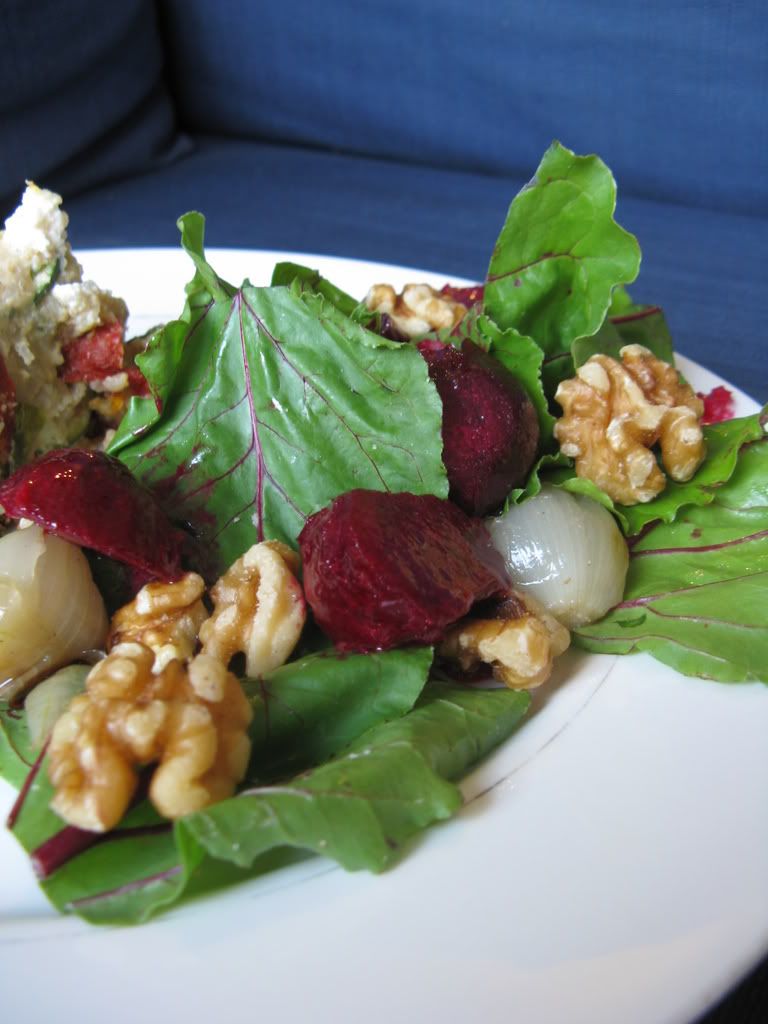
Baby I love you Beet.


Baby, I love you.
I love it when you blush, you turn beet red.

Beets are a miracle, it contains potassium, folate and manganese.
Reserve the leafy tops as it contains beta-carotene, calcium and iron.

The red pigment contains certain anti-cancer agents and are also used as a red dye.


Choose beets that are small and firm. It should be deep maroon in colour, have unblemished skin and fresh bright green leaves. The tap root should be attached.

Avoid large beets which have a hairy taproot,
as these are signs of age and toughness.
Smaller beets will be sweeter and more tender (~2 inches in diameter).

Store the root and the leaves separately. The leaves will keep for 2 days in plastic.
Trim the leaves 2 inches from the root, do not trim the tail. The root bulbs can be stored for a week in the vegetable compartment.

Beets may even be frozen.

Cooked or canned beets can be stored for one week. Do not store canned beets in the can, use a plastic container to avoid oxidation.

Cooking suggestions:

1) RAW!!!! - Wonderful when julienned into 3 mm thin slices. It gives an extra dimension to your salad or toasted sandwich. I just love the tangy taste.


2) Baked.
3) Steamed.
4) Fried
5) Grilled
6) Boiled - Cooking the beets in soup will leech its colour into the water. Afterwhich the beets will absorb the taste of the soup and become little cubes of savoury flavour, resting in red liquid. You can shape the beets into little parodies of bodyparts just because its more interesting for halloween.

Hurray to Beets!
-30-

Friday, October 23, 2009

Counting Calories


Yes!!! Celery sticks is the way to go. For one serving size, you get 15 calories only and a super boost of Vitamin A & C.

Choose straight, rigid celery stalks with fresh leaves. The celery should not be limp, pithy or smell musty. A good way to test is to give it a light squeeze and if it doesn't squish, its good to eat.

You can keep fresh celery wrapped in a plastic bag for one week.


Cooking suggestions:
1) RAW - This is really the best way to eat this vegetable.
Run a peeler over the front of the vegetable to remove tough epidermis and cut off the ends. Chop into 1 cm thick slices and consume with sour cream, chopped apples and cooked shrimp. Delish!


2) Baked - Wonderful taste!
Bake in a toaster oven half a stalk. Remove the tough outer layer and place cheese and chopped surimi in the inner 'bowl'. Toast to perfection. Yum!


3) Stir fried
4) Boiled
5) Grilled

When celery is just done, they should turn a cheery green compared to its raw pale green state. If finely chopped, the inside of the stem will turn just transluscent. Raw or cooked, cellery is just one of the best tasting vegetables ever!

Delish!

-30-

Sunday, October 18, 2009

Brinjal

Healthy Eating with Brinjal!!!

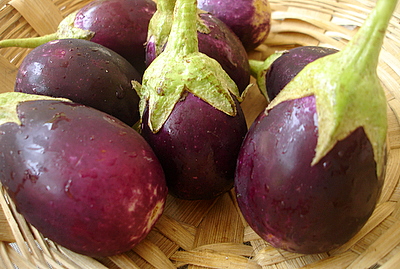
Hi, I'm sure that majority of the population takes a look at the vegetable on the right and go, "Eeks! I'm not going to eat That!"


These firm, deep purple and cute little plants are called Brinjal or Egg plants.
The stem should be firm, the body smooth and without wrinkles.
The skin should be smooth and shiny. In fact, you should treat a brinjal like you would a wife! Love it!

Brinjal are an excellent food source, with off-white colour pulp and soft edible seeds.

It is low in calories and high in fiber; vitamin B6; and minerals, copper and manganese.

Suggested cooking method:
  • Grill
  • Pan fry
  • Bake
  • Boil in Curry
  • Steamed
  • Fried
Personally, I like to use the first three methods to cook the brinjal as it retains the most taste of the vegetable.
All you need is to oil and very lightly salt and pepper the brinjal. Cook till just soft.
Another advantage of cooking brinjal is the change in colour of the skin (purple -> light brown) and flesh (off-white -> light grey) which is observable when cooked.

YUM!

-30-

Wednesday, October 14, 2009

Super Sized Me!

IBL material for home economics, maybe?


.