Showing posts with label Food. Show all posts

Wednesday, December 9, 2009

Carrot and the Stick

Let me eagerly enjoy my sweet carrots.
Carrots are very low in saturated fats and cholesterol.

Good source of dietary fibre, vitamin A and vitamin C.

Carrots can be harvested while they are still immature.
Immature/ fresh-market carrots can be stored for 4 to 6 weeks at 0 degree Celcius and high (95 - 99 %) humidity.
Mature carrots can be stored up till 5 months in the same conditions.


Select carrots which are firm and darker orange, this indicate higher beta-carotene content. Avoid selecting dry, cracked, wilted or limp carrots which are pale in colour.


Cooking suggestions:

1) Raw - Shaved in salads or use baby carrots as vegetable sticks for dipping in sour cream.

2) Boiled - In soups, carrots give a rich sweet taste in soups when coupled with other root vegetables.

3) Steamed
4) Baked

5) Grilled - Grilling carrots makes it crisp on the outside and soft on the inside. We can season the carrots with Thyme and salt lightly. Remember to oil the carrots directly before grilling.

Yum!


-30-


Tuesday, December 1, 2009

Hot Line SOS - "Kelp Me!"

Kelp are large seaweeds belonging to brown algae.

You normally find them dried in the market.


They are a good source of Dietary Fiber, Vitamin C, Calcium, Iron, but can be high in sodium.

Storage Tips:
Keep dried kelp in a cool dry place, away from salt.
Use dehumidifiers if necessary.

Cooking Suggestions:

Always soak dried kelp at least 15 mins before consumption. Different types of kelp require varying times of pre-soaking before they can be consumed.

You can boil them for 5 to 10 mins, again depending on the type of kelp you are eating. Thicker kelp take longer to cook.

I prefer to take my kelp in a light seaweed soup with tofu and dried shellfish.

However, thinner types of kelp, like the japanese wakame does very well in salads too.

-30-

Thursday, November 19, 2009

Zucchini


Sweet Zucchini, Where art thou?

Zucchini are a member of the cucurbit family, that means they are in cousins with watermelons, gherkins and cucumbers! They are usually marrows harvested at a young age.

Zucchini have high water content and low in calories. It also contains Vitamins A and C, folate and potassium.

Choose zucchini that are smaller and younger as they are sweeter. It should be firm and heavy with unblemished, bright & glossy skins.


You can store zucchini for 5 days in the fridge. Wash and trim both ends before cooking.

Cooking suggestions:
  • Baking - I like to bake my zucchini with a bit of salt and olive oil. You can add a dash of honey on top if you like the light flora fragrance it gives. You can also bake zucchini in bread!
  • Boiling
  • Frying
  • Steaming
  • Stewing


-30-

Sunday, November 15, 2009

Microteaching session 6

Hello...

Microteaching has resumed this week, after a 2-week lecture by MOE HQ personel. Presenting to you dishes by Hilyah, Shuen and Siew Feng!

Topic:

Seafood is a very popular in many cultures and is now a common feature in our local diet. Make a study of the nutritional contribution of seafood and show how you could provide a balanced diet that includes an interesting selection of seafood dishes.


We were greeted with a "kampong" theme setting in the beginning of the lesson. *Slurp!*


Laksa in a coconut!

The all-time favourite dish among most Singaporeans.

Last but not least, otah with pomelo salad!

The microteaching session commenced with a introduction to various spices we could obtain from the Southeast Asian region. We were also taught the difference between herbs and spices.


The first dish we learnt was the making of curry laksa. It was said that the origins of laksa were unknown, but it was suggested that the name of this dish could have originated from the word lakhshah , which is a type of vermicelli. Another theory suggests that it could have come from "la sha", meaning "spicy sand", due to the presence of ground dried prawns which make the gravy taste "sandy".


The next dish we learnt was otah. This name of this dish could have originated from the word "otak", meaning "brains" in malay. Since otah is soft and squishy, it resembles "brains", thus its name.


The final dish, which was the most challenging among all dishes prepared today, was chilli crab. We were taught how to kill a live crab swiftly with just 1 wooden chopstick.

Anatomy of a yummy crab


All that was needed was to invert the crab (of course, with its pincers already secured tightly with raffia), remove the abdomen, position the chopstick at its middle region and pierce the chopstick into the crab after moving ur chopstick a little to the left hand side.

Leave the chopstick pierced in the crab and let it struggle for a while. Remove the raffia strings only after ensuring that the crab has turned lifeless. If it still shows signs of life, pierce with the chopstick into another region of the crab near the centre one more time.

Preparation for this dish was satisfying, especially after experiencing for ourselves how easy it is to kill it. Eat frozen crabs no more! Boiling them alive is no longer necessary also.

Both Esther and I enjoyed all 3 dishes prepared in this session. Laksa was topped with generous amounts of ingredients - taupok, fish cake, beansprouts. Wrapping the otah with blanched banana leaves was fun too, and the ratio of various spices used was just right for me. It was also satisfying to enjoy eating otak made entirely from fish meat! As for the crab, on top of the satisfaction gained from killing the crab, the gravy was sedap! It went perfectly with the steamed chinese buns.

Thursday, November 12, 2009

Microteaching 4

Hello! Here are the dishes prepared for Jannah, Emilia and Yani for Microteaching 4.


Topic:
Healthier food choices may taste bland and look boring. Show with examples how our regular diet can be made healthier and more appetising.


The teachers prepared a purple-and-pink modern-dining setting this week.


This quiche made me really hungry.


This would be perfect for breakfast too! Succulent kebabs!


Nasi Goreng in a green apple! Decked with roses made from cucumber and tomato slices. Really pretty!


These were the dishes prepared by Esther and I:


The zucchini slices and chicken cubes were a little charred haha! But the marinate was delicious, enjoyed it loads!


We gobbled this up immediately after microteaching. Yum!

Salmon and spinach quiche! Yum! Wish we would have prepared more of it. It tasted great!




Saturday, November 7, 2009

Lady Viridian


My fair Lady Viridian, Hibiscus esculentus.
You charm even the most fiery sauces in curries, and yet is as fresh as the dew on salads.

Lady's fingers is a fruit vegetable. Normally wrapped in plastic, they can be stored for a week under 24-26 degree Celcius.
Unwrapped fruits last for 2 days.


The seeds and its pods are edible and Lady's fingers contains vitamin A, calcium and protein.
They contain neither starch nor sugar. The perfect food for diabetics.

Suggested Cooking methods
  • Raw
  • Boil
  • Deep Fry
  • Pan Fry - Pan fry with belacan and peanuts. Yum!

-30-

Saturday, October 31, 2009

"Good"? Or "bad"?

Hi everyone!

Just few weeks ago, I believe most of us would have heard on the news about several Singaporeans queuing up for hours for the launch of the new Microsoft Windows 7 Operating System.

Well, what has its launch have to do with us, as FCS teachers?


This video can serve as a sequel to Jeline's Home Economics microteaching (remember the video on the multiple-patty burger?)!

It's a home-made video comprising of several videos I found on Youtube. Made and used it as an opening for Biology microteaching. Hope you've enjoyed it!

It is evident now that fad of selling big-portioned fastfood at affordable prices is no longer restricted to countries in the West, and there is actually a market for such extra-large portion foods in Asia. Obesity rates in Asia are also escalating as the years progress, particularly in China, Japan, the Philippines, and not forgetting our dear Singapura.

Honestly speaking, I think many teenagers today (and I am guilty of that myself) might develop positive thoughts upon knowing about the burger (and likely to want to try it) contrary to what Homec teachers may think, especially meat and fast-food lovers. Also, since the patties look thin and seemingly "harmless", students may not know how many calories they are actually consuming.

What I like about creating videos like this one is that it is current news which upper secondary and IT-loving students will be interested. Also, it is factual which will probably be more impactful to students. (The part where the reporter stated the total no. of calories in this burger which is close to the average calorie intake of a healthy adult.)

The sequence of this video also aids in creating this impact; Students will first get to see the burgers and people enjoying it, and be shocked later to find out the number of calories it contains. The element of surprise may (hopefully) enable them to link facts learnt in their textbook to current affairs/everyday situations, thus making learning more enjoyable and meaningful.

Learning about the total number of calories per burger will also allow students to make comparisons with other types of food (and their total calories) easier, since they are now in quantifiable terms. Ever did I consider making the video more "gory" by showing photos of clogged arteries and obesity, but these plans were scrapped as I was worried about the message I would be sending to my students. After all, eating just one Windows 7 burger, or any other humongous burger in the video, will not directly lead to clogged arteries and obesity.

Also, since this news is closer to home, learning about dietary planning will be more meaningful to students as it is authentic. Above all, the inclusion of popular music in this video in the opening will garner their attention onto the main part of the video, which is the launch of this new burger.

More often than not, people tend to name foods as "bad" and "good". In my opinion, I feel that it is inappropriate to label foods as "bad" or "good", as it is inevitable that we indulge in such foods at times. What is "good" may not be "good" if eaten in the wrong quantity, while what is "bad", well... what's so bad about indulging in such foods once in a while?

Rather, wouldn't it be better if students are informed about what is in their food, so that they themselves decide if they should eat it or not (or how frequent), ie. making informed decisions and learning how to be responsible for their own health?

To be honest (again), despite knowing what fastfood can do to me, I could still not resist participating in the pursuit in winning Sentosa Cove for the MacDonald's Monopoly publicity stint when it was just introduced to Singapore. Much less giving up my all-time favourite McNuggets and French Fries, despite knowing they have been happily deep-fried in litres of hot oil.

Guess it still boils down to Variety, Moderation, Balance, and making wise decisions.

Thursday, October 29, 2009

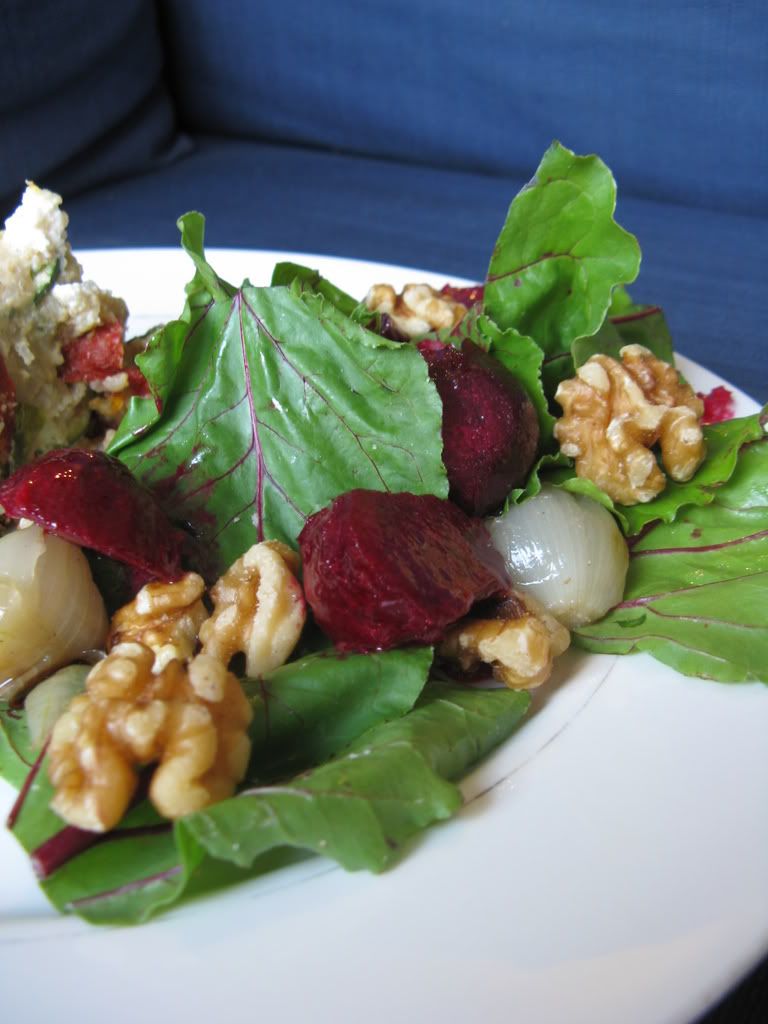
Baby I love you Beet.


Baby, I love you.
I love it when you blush, you turn beet red.

Beets are a miracle, it contains potassium, folate and manganese.
Reserve the leafy tops as it contains beta-carotene, calcium and iron.

The red pigment contains certain anti-cancer agents and are also used as a red dye.


Choose beets that are small and firm. It should be deep maroon in colour, have unblemished skin and fresh bright green leaves. The tap root should be attached.

Avoid large beets which have a hairy taproot,
as these are signs of age and toughness.
Smaller beets will be sweeter and more tender (~2 inches in diameter).

Store the root and the leaves separately. The leaves will keep for 2 days in plastic.
Trim the leaves 2 inches from the root, do not trim the tail. The root bulbs can be stored for a week in the vegetable compartment.

Beets may even be frozen.

Cooked or canned beets can be stored for one week. Do not store canned beets in the can, use a plastic container to avoid oxidation.

Cooking suggestions:

1) RAW!!!! - Wonderful when julienned into 3 mm thin slices. It gives an extra dimension to your salad or toasted sandwich. I just love the tangy taste.


2) Baked.
3) Steamed.
4) Fried
5) Grilled
6) Boiled - Cooking the beets in soup will leech its colour into the water. Afterwhich the beets will absorb the taste of the soup and become little cubes of savoury flavour, resting in red liquid. You can shape the beets into little parodies of bodyparts just because its more interesting for halloween.

Hurray to Beets!
-30-

Tuesday, October 27, 2009

**Chief Eric ** Cooking Class!!

Chief Eric Cooking Demonstration Class! 


Chief Eric in the house ~~


 Hillyah and Me.. With Chief Eric..


Two dishes for the day..


Green leafy with fresh water prawns, tangy oranges.


Mustard Chicken with Herb Crust 
Accompanied with Thai Asparagus, Yellow Zucchini & Mashed Potatoes


Some Learning Points..

1st - Introduce the Pink Peppercorns (below)

Many of us are familiar of black & white peppercorns. Pink peppercorns are less seen in any recipes.

So what's is the difference?


In the market, there is a variety of peppercorns. They come in black, white, green and pink. Black pepper is produced from unripe berries of the pepper plant. White pepper consists of the seed only, with the skin of the pepper removed. Green pepper, like black, is made from the unripe berries but they are treated in a manner that retains the green colour. Pink peppercorn consists of ripe red pepper berries preserved in brine and vinegar.

2nd - How to make red bell peppers more fragrant?


BURN bell peppers over the fire.. .. 


Flip the peppers once it turn black


 Once the whole pepper turn black.. place it into a plastic bag and seal it..


 The condensation of the vapor from the peppers will allow the black char to be remove easily under running water..   


3rd - Good organization!


Ingredients are all laid neatly on the workbench...

Friday, October 23, 2009

Counting Calories


Yes!!! Celery sticks is the way to go. For one serving size, you get 15 calories only and a super boost of Vitamin A & C.

Choose straight, rigid celery stalks with fresh leaves. The celery should not be limp, pithy or smell musty. A good way to test is to give it a light squeeze and if it doesn't squish, its good to eat.

You can keep fresh celery wrapped in a plastic bag for one week.


Cooking suggestions:
1) RAW - This is really the best way to eat this vegetable.
Run a peeler over the front of the vegetable to remove tough epidermis and cut off the ends. Chop into 1 cm thick slices and consume with sour cream, chopped apples and cooked shrimp. Delish!


2) Baked - Wonderful taste!
Bake in a toaster oven half a stalk. Remove the tough outer layer and place cheese and chopped surimi in the inner 'bowl'. Toast to perfection. Yum!


3) Stir fried
4) Boiled
5) Grilled

When celery is just done, they should turn a cheery green compared to its raw pale green state. If finely chopped, the inside of the stem will turn just transluscent. Raw or cooked, cellery is just one of the best tasting vegetables ever!

Delish!

-30-

Tuesday, October 20, 2009

Our R&R session!

Our R&R session! 
a Japanese Restaurant @ Lower Seletar

Homely Setting.. .. 


Amelia ordered Japanese Curry Don
 
Chunks of beef and pork in mild spicy curry sauce.. ..
Combination of different texture of beef & chicken adds on to the mouth-feel of the entire dish.. .. .


 I ordered the Katsu Don..

Looks ordinary.. But taste "not ordinary".. 
The egg white and yolk is runny.. smooth, slips down your tongue instantly.. 


Esther ordered salmon fish head with soba


What this? Fish eye has plenty of nutrients


It helps to lowers the risk of muscular degeneration, contains collagen protein and unsaturated fatty acids.


Our side dish

Baby shrimps.. Eat with the shell and head..


Sunday, October 18, 2009

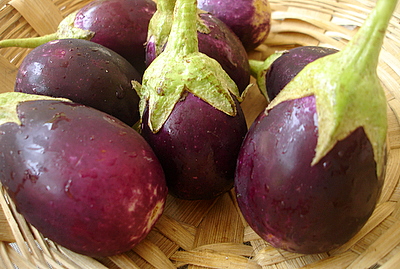
Brinjal

Healthy Eating with Brinjal!!!

Hi, I'm sure that majority of the population takes a look at the vegetable on the right and go, "Eeks! I'm not going to eat That!"


These firm, deep purple and cute little plants are called Brinjal or Egg plants.
The stem should be firm, the body smooth and without wrinkles.
The skin should be smooth and shiny. In fact, you should treat a brinjal like you would a wife! Love it!

Brinjal are an excellent food source, with off-white colour pulp and soft edible seeds.

It is low in calories and high in fiber; vitamin B6; and minerals, copper and manganese.

Suggested cooking method:
  • Grill
  • Pan fry
  • Bake
  • Boil in Curry
  • Steamed
  • Fried
Personally, I like to use the first three methods to cook the brinjal as it retains the most taste of the vegetable.
All you need is to oil and very lightly salt and pepper the brinjal. Cook till just soft.
Another advantage of cooking brinjal is the change in colour of the skin (purple -> light brown) and flesh (off-white -> light grey) which is observable when cooked.

YUM!

-30-

Wednesday, October 14, 2009

10 course Christmas Extravaganza


Christmas is round the corner.. 

Lets have a 10 course Christmas Extravaganza!
(More @ ieatishootipost)


Excellent pictures! Look at the presentation..

Super Sized Me!

IBL material for home economics, maybe?


.

Thursday, October 8, 2009

Microteaching 3

Hi everyone!
This were the dishes Esther and I made for this week's microteaching (6 Oct 2009), taught by Lee Kuan, Zuzi and Jessica.
Topic:
Modern technology in food production and household equipment has helped make food preparation at home faster and easier. Show how healthy dishes could be prepared using a variety of such technology.


Chicken rice with Acar.

This was Esther's favourite dish! The rice cooker was used to steam the chicken and cook the rice.


Wholemeal egg tart (left) and Chicken Pao (right)

I personally enjoyed the egg tart since (as mentioned earlier) I love sweet food! The food processor was used to mix the butter and flour, while the oven was used to bake the tart.

The chicken pau was, in our opinion, the most enriching lesson we had so far! We've learnt a lot on the theories behind the procedures. The electric steamer was used for steaming the pau.

...